When ships sailed into the city centre
St Augustine’s Parade looks very different today from the Bristol encountered by earlier generations.
Until 1892, ships could sail into the city along the River Frome. A drawbridge remained in use until 1827, allowing vessels access while providing a crossing from one side of the river to the other.
Bristol was then an international port second only to London. According to one often-repeated story, the harbour could become so crowded that it was possible to cross from one side to the other by walking across the decks of moored ships.
Some of the 18th-century houses still survive along St Augustine’s Parade, providing a reminder of the city that developed beside this extraordinarily busy waterway.
Theatre at the heart of Bristol
One of the most prominent buildings on St Augustine’s Parade is the Bristol Hippodrome.
Designed by celebrated theatre architect Frank Matcham, it opened in December 1912 for musicals and opera.
Matcham was responsible for some of Britain’s best-known theatres, including the London Coliseum, Palladium, Hackney Empire and Victoria Palace.
Nearby buildings and monuments reveal other layers of Bristol’s history — from the statue of Neptune, which has occupied several locations around the city since the 18th century, to the Cenotaph designed by Bristol’s first female architect, Eveline Dew Blacker, working with Harry Heathman.
Bristol and the slave trade
This part of the city also confronts visitors with one of the most difficult aspects of Bristol’s history.
A replica ship’s figurehead above the former Drawbridge pub recalls Bristol’s long involvement in the sugar trade. During the 18th century, sugar became one of the city’s most profitable imports.
That prosperity was inseparable from the transatlantic trade in enslaved people and the plantation economies that produced commodities including sugar, tobacco, cocoa and coffee.
Nearby stands the empty plinth that once supported a statue of Edward Colston, a Bristol merchant who profited from the slave trade and later became known for charitable giving.
The statue was pulled down during a Black Lives Matter protest on 7 June 2020 and thrown into the harbour. It was subsequently recovered and taken to M Shed.
Up the Christmas Steps
Leaving the broad city-centre streets behind, the character of the walk changes dramatically at Christmas Steps.
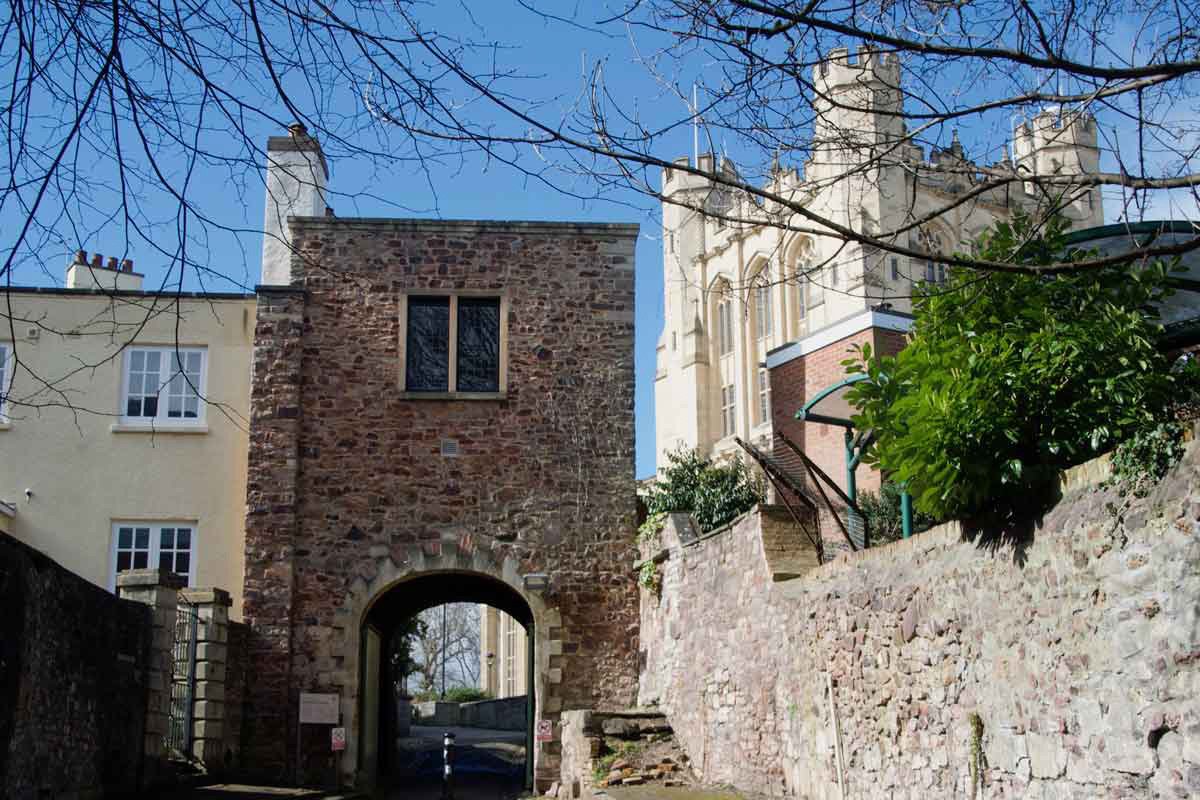
The entrance to the steps lies beside the remains of the medieval St Bartholomew’s Hospital. Following the Dissolution of the Monasteries, the hospital was converted into a Free Grammar School.
Christmas Steps itself has carried several names. Originally a stone path, the steps were constructed in 1669 with money provided by Sheriff Jonathan Blackwell.
Today they lead into Bristol’s Arts Quarter, an intimate collection of historic buildings, independent shops and galleries that feels remarkably removed from the modern city centre only a short distance away.
At the top stand almshouses originally founded by wealthy salt merchant John Foster in 1484, together with the Chapel of the Three Kings of Cologne.
Bristol’s first trams
At the junction of Perry Road, Maudlin Street and St Michael’s Hill, another chapter of Bristol’s transport history began.
In 1875 the city’s first horse-drawn tram carried passengers from the King David Hotel towards Redland.
Electric trams followed in 1895, making Bristol the first city in the United Kingdom to introduce them.
At their peak, 237 tramcars operated across 17 routes.
The system finally ceased operating in 1941 after a Luftwaffe bomb destroyed its main power supply cables.
Civil War and the Royal Fort
Climbing towards the university brings the walk to Royal Fort, a site closely associated with the English Civil War.
During the Storming of Bristol in July 1643, Royalist forces commanded by Prince Rupert captured the strategically important port from its Parliamentarian defenders.
The original fortifications were later ordered to be demolished by Oliver Cromwell.
Royal Fort House was subsequently commissioned in 1767 by wealthy merchant Thomas Tyndall. The house incorporates Baroque, Palladian and Rococo influences, while its gardens were later laid out by Humphry Repton, one of Britain’s most celebrated landscape designers.
Science above the city
Today Royal Fort forms part of the University of Bristol.
The imposing Physics Building dates from the early 20th century and was designed by Sir George Oatley.
In front of it stands a statue by Helen Wilson-Roe of Henrietta Lacks, the African-American woman whose cells became invaluable to medical science.
Those cells have contributed to research and treatments ranging from the polio vaccine to work on viruses and vaccines.
The route eventually leaves the university quarter towards Park Row and the Red Lodge, a surviving fragment of the great house and gardens once created here by the Young family during the 16th century.
What you’ll discover
St Augustine’s Parade is a walk through some of the most dramatic changes in Bristol’s history — from a city crowded with sailing ships to the modern cultural and university quarter.
- St Augustine’s Parade — once beside a harbour filled with ships in the heart of Bristol.
- Bristol Hippodrome — Frank Matcham’s great Edwardian theatre.
- Christmas Steps — one of Bristol’s most distinctive historic streets.
- St Michael’s Hill — an old route climbing away from the polluted medieval city.
- Royal Fort — a landscape shaped by Civil War, Georgian wealth and the university.
- University Quarter — architecture, science and stories of discovery above the city.
- Red Lodge — a surviving connection with a Tudor great house and its gardens.
The complete City Walks Bristol guide follows the route from the city centre into the hills above it, uncovering many more stories hidden among its monuments, steps, historic houses and university buildings.