Brunel’s bridge across the Avon Gorge
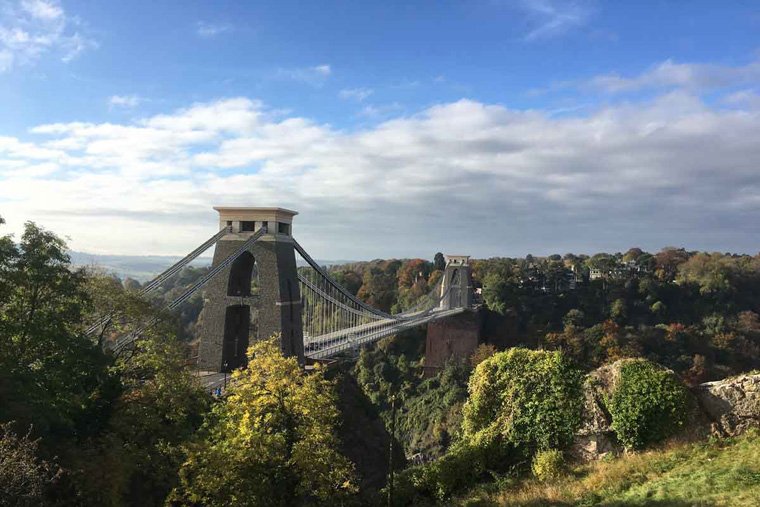
Clifton Suspension Bridge spans the Avon Gorge and River Avon, linking Clifton in Bristol with Leigh Woods in North Somerset.
Isambard Kingdom Brunel entered the competition to design the bridge alongside established engineers including Thomas Telford. The first competition, held in 1829, was judged by Telford, who rejected the submitted designs and proposed one of his own. The decision proved unpopular and a second competition followed in 1830, when Brunel emerged victorious.
Construction began in 1831, but the project was soon beset by difficulties. Following rioting in Bristol later that year, investors lost confidence and work on the bridge stopped for four years.
Brunel remained committed to his ambitious project and construction recommenced in 1835.
A bridge Brunel never saw completed
Money continued to trouble the project. In 1843, funds ran out again and construction stopped — this time for almost twenty years.
Work finally recommenced in 1862 and Clifton Suspension Bridge opened to the public in 1864.
Brunel never saw his bridge completed. He had died in September 1859, three years before construction resumed and five years before the bridge opened.
During the long life of the project, Brunel made significant changes to his original design, including the use of re-engineered suspension chains recovered from an earlier bridge.
High above the gorge
The bridge isn’t the only remarkable structure overlooking the Avon Gorge.
Clifton Observatory stands high on the cliff above it. Built in 1766, the building was originally used for corn before being converted into a snuff mill.
After a fire in 1777 it stood derelict for around fifty years until local artist William West took it on as a studio. He rebuilt the mill and, in 1828, converted it into an observatory, installing a Camera Obscura that provides a panoramic view of the surrounding landscape.
West also excavated a tunnel through the rock beneath the Observatory. Known at different times as the Giant’s Cave, Glyston’s Cave and St Vincent’s Cave, it descends through the cliff before emerging at a viewing platform high above the gorge.
From Clifton to the Downs
The walk continues through one of Bristol’s most distinctive neighbourhoods.
Along the route is Clifton College, whose Big Hall was designed by C. Hansom in 1862. The college’s former pupils include John Cleese, Michael Redgrave and Douglas Haig.
The route also passes the site of Bristol Zoological Gardens. Founded in 1835 following the formation of the Bristol, Clifton and West of England Zoological Society, Bristol Zoo became one of the oldest zoos in the world.
Beyond Clifton lies the great open landscape of Durdham Downs — 442 acres of woods and grassland crossed by numerous paths.
Views across the Bristol Channel
At the Sea Wall, built by John Wallis in 1746, the landscape opens to views across the Bristol Channel towards the Welsh hills.
A path across the Downs follows the line of an old Roman road before reaching Blackboy Hill and Whiteladies Road.
Whiteladies Road was once an important route into Bristol and onwards towards London and Bath. Following it back towards the city brings the walk past familiar Bristol landmarks including the Victoria Rooms and the Royal West of England Academy.
What you’ll discover
This is one of the longest and most varied City Walks Bristol routes, combining engineering, architecture, social history and some of the city’s finest open spaces.
- Clifton Suspension Bridge — Brunel’s extraordinary crossing of the Avon Gorge.
- Clifton Observatory — a former snuff mill transformed into an observatory.
- Giant’s Cave — a tunnel through the rock to a viewpoint above the gorge.
- Clifton College — one of Clifton’s defining Victorian buildings.
- The Downs — hundreds of acres of grassland and woodland above the city.
- Sea Walls — far-reaching views across the Bristol Channel towards Wales.
The complete City Walks Bristol guide follows the route through Clifton and the Downs, revealing many more of the people, places and stories encountered along the way.